
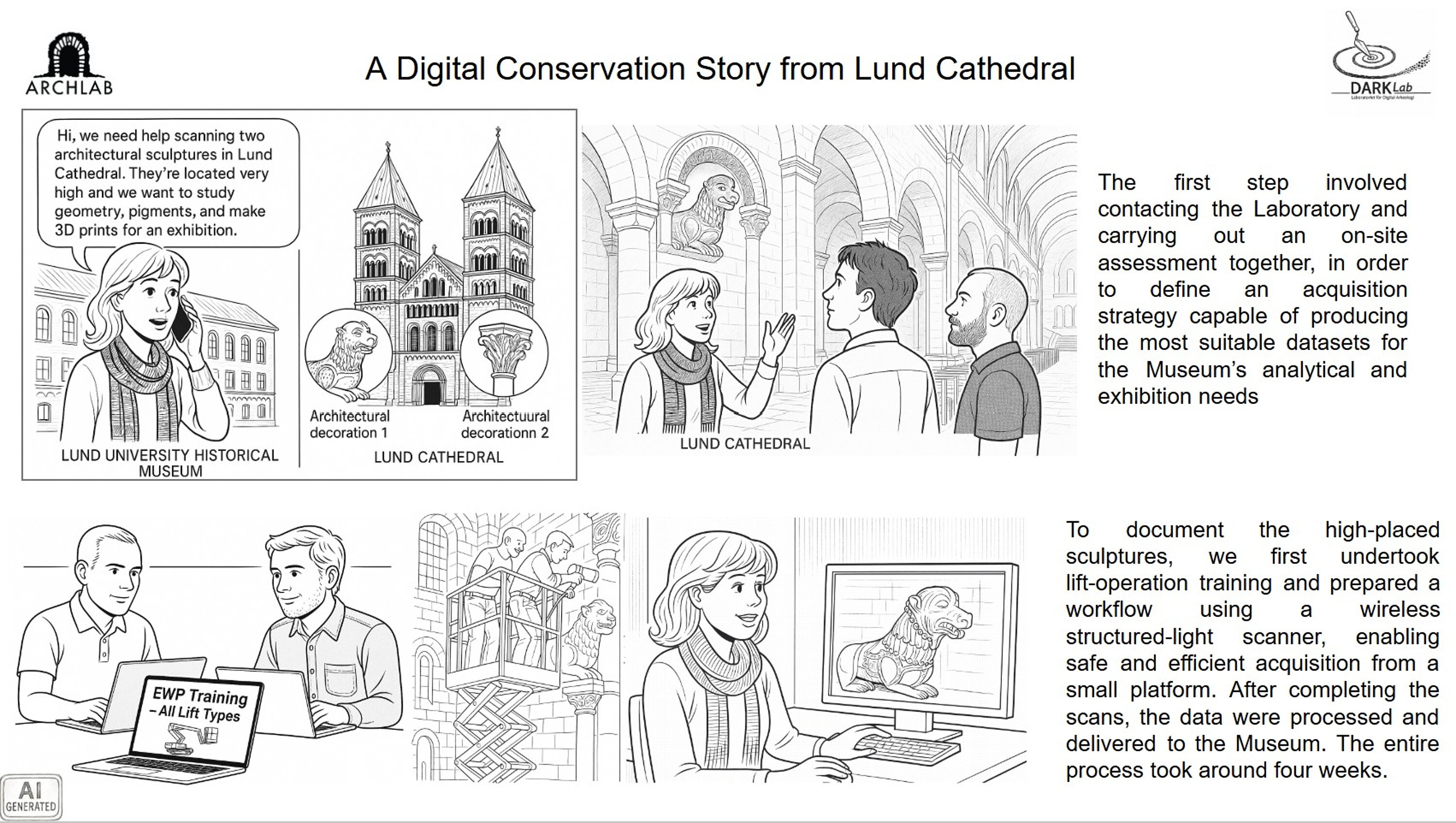
Technical Workflow Overview
Initial contact with the Laboratory can be made either through the DARKLab website or via the ArchLab user-access pages. Once the request is received, the first step consists of gathering preliminary information about the object or site. When feasible, this includes an on-site assessment to review the location, evaluate environmental constraints, and jointly define the most suitable acquisition strategy with the user.
The acquisition strategy is always designed starting from the user’s research aims. These aims determine the level of geometric precision required, which in turn guides the choice of instruments, acquisition parameters, and post-processing workflows. It is important to emphasise that each 3D visualization results from a specific, purpose-built pipeline, and therefore reflects distinct affordances and analytical potentials.
When the object is located in a difficult-to-access position, an evaluation is carried out to determine the safest and most efficient way to reach it. In this case, the team initially considered using a drone; however, the geometric complexity of the sculptures required a sensor capable of capturing fine surface variation. Structured-light scanning provided the necessary accuracy, whereas image-based modelling (while viable) would have resulted in regions of lower geometric fidelity, particularly in deep recesses, undercuts, and areas with limited texture or unfavourable lighting.
The scans were aligned using high-precision registration procedures, and once a high-resolution point cloud were produced, the models were meshed following a carefully optimised workflow to preserve detail while reducing noise and file size. After optimisation, both the processed models and all associated raw data were delivered to the user. A web-based 3D version of the model was also published, allowing museum staff to access and inspect the high-resolution dataset directly through an online platform.


3D Acquisition – Artec Leo
For this project the sculptures were recorded with an Artec Leo structured-light 3D scanner. Leo is a wireless, self-contained handheld unit with an integrated touch screen, on-board GPU processing and battery power, which allowed the operator to work safely from a small lift platform without any external cables or laptop. The sensor captures geometry and colour simultaneously, with a 3D point accuracy of up to 0.1 mm and a resolution down to 0.2–0.3 mm, and supports real-time reconstruction at up to 80 frames per second.
The lion relief was acquired using target-free tracking based on geometry and texture. Scanning was carried out at an average working distance of c. 0.5–0.8 m, following overlapping passes that covered all visible faces of the sculpture and surrounding masonry in order to support later alignment and contextual visualisation. Exposure and LED intensity were adjusted on site to minimise specular highlights on the painted surface. For each sculpture, several high-quality passes were recorded and stored as separate Leo projects for subsequent processing.
Processing Workflow – Artec Studio 18
The raw Leo data were processed in Artec Studio 18. Individual scans were first cleaned of background noise and mis-tracked frames, then rigidly aligned using feature-based registration. A global registration step refined the alignment across all passes, followed by outlier removal and smoothing constrained to sub-millimetre scale to preserve fine carving.
A high-resolution Sharp Fusion was generated at an effective grid size of approximately 0.3 mm, producing a watertight triangle mesh of the lions and their architectural support. Small gaps in non-critical areas were filled automatically. High-resolution colour textures were computed from the Leo RGB frames, optimised for even illumination and colour balance. The final dataset was exported in OBJ + MTL + texture format for archiving and web visualisation, together with a decimated mesh for interactive use.
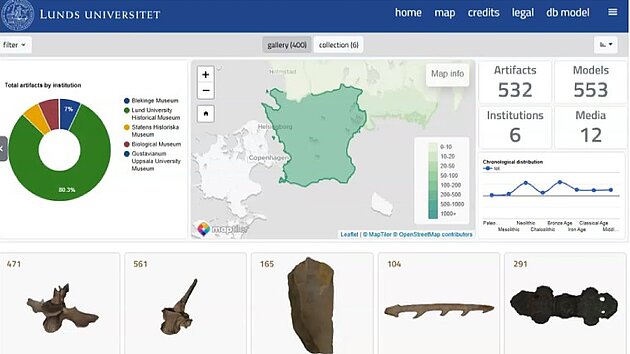
Online Publication – Dynamic Collections & 3DHOP
The resulting models were published through Dynamic Collections, Lund University’s web platform for 3D archaeological data. Within Dynamic Collections, the sculptures are are visualized through the 3DHOP (3D Heritage Online Presenter) framework, which converts the OBJ model into a multi-resolution NEXUS format and streams it efficiently in the browser using WebGL.
3DHOP enables smooth interaction with high-resolution models directly online, including real-time orbit, pan and zoom, multiple lighting presets, and measurement and section tools. In Dynamic Collections, these functions are combined with rich metadata, links to related objects and collections, and options to download full datasets (if stored through a long term repository). This workflow ensures that the same 3D dataset can support on-site analysis, museum exhibition planning, 3D printing and long-term open access for researchers and the wider public.